- Carti
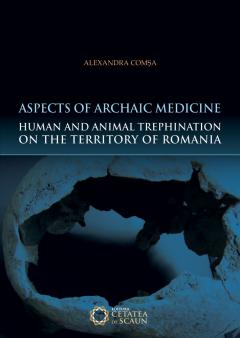
- Aspects of Archaic Medicine. Human and Animal Trephination on the territory of Romania Alexandra Comsa
Aspects of Archaic Medicine. Human and Animal Trephination on the territory of Romania Alexandra Comsa
Opinia clientilor
Vandut de: carturesti.ro
35,00 Lei
In stock
Livrare standard
Vineri, 18 Sep. – Duminică, 20 Sep.

Ridicare personala din Showroom
informatii insuficiente

Returnare
14 zile calendaristice de la primirea coletului
CarteCetatea de Scaun
Cumpara Aspects of Archaic Medicine. Human and Animal Trephination on the territory of Romania Alexandra Comsa de pe carturesti.ro, la pretul de 35,00 lei.
The specialized literature often provides examples of trepanned human skulls. They are usually spectacular, as people are amazed to find that such a surgical operation could have been performed in archaic times. Yet, seldom, we have also encountered ethnological proofs about the existence of the mentioned practice, also for the case of domestic animals, especially, sheep, cattle and horse. Such a topic, like the intervention upon the brain case, which is very risky, even today, when being done with modern equipment, did always stir a large interest, among anthropologists, historians of medicine and archaeologists, not to mention the public. Yet, we were astonished to find that, most of the mentioned specialists do not know about the interesting results of the ethnological investigation, which, at least in Eastern Europe has brought significant evidence about the practice of trephination upon domestic animals. We have never seen, or found, a book or article strictly regarding such a practice on animals, even if the Romanian specialized literature, for instance, made some remarks about this topic. Unfortunately, we detain some slight information, which was sporadically mentioned but, a lot more must have been lost in time, due to the progress of civilization. We consider that as being the consequence of an anthropocentric perspective, which did not take into account the most important thing, which is, the possibility of having rescued the life of some humans, or animals by that intervention. Besides, in most situations, the scientists use the information they could obtain from their own training, often neglecting the one provided by other fields of activity. This is a reason why, in the past decades, the interdisciplinary studies had been initiated. Yet, we do not see too often, such an association, between archaeologist, ethnologist, anthropologist and historian of medicine. In our view, such a team would bring new aspects and interpretations about the old medical practices. As concerns the trephination upon animals, we should take into account the fact that, one of the most important aspects of the social and economical life is food production. In such a process, in the archaic societies, a very important role was played by domestic animals. Therefore, when having a valuable animal, a family did its best in order to cure its illnesses. Even today, in such a situation, the veterinary assistance is highly appreciated when being focused upon a special breed, or upon an animal with very good capacities. We also consider that, the mentioned practice performed upon animals, must have been more frequently used and highly developed by the nomadic populations, for whom such an ill, or ineffective animal would have been a burden during their movements. This is how the trephination upon animals was disseminated, and, considering our data, it is most possible that it could have been brought on the territory of Romania by the ancestors of the today Hungarians. We could not say which of the trephinations emerged first, namely those performed upon humans, or animal skulls. If we think carefully, we do not even have any arguments about that. According to our knowledge, it seems that the human one appeared first and afterwards the intervention made upon animals. Of course, future finds might bring also arguments about the reverse situation, but this is what we know at this moment. In the following lines, we would also tackle another issue. Even if we hardly accept this idea, the healing appeared in immemorial times. Illnesses of both humans and animals, are not specific to recent times. They affected each individual, depending upon certain influences of environmental factors, or weakness of the body. It is a fact that, even in our times, people can get a disease in certain moments of their lives. Still, we should emphasize that a comparison between the archaic and recent communities is not very reliable, due to the fact that in older times, the immunity of the individual was better than today, when the body is permanently under the “pressure” of pollution and stress. Besides, the people of those times were gathered in small groups that could not get in contact with each other, except within a longer time. At present, one can reach any part of the world, with the modern transportation means that exist. Yet, even today, a disease specific of a certain region can be taken over from someone who lives far away and can die from that, despite the advanced medical treatment. This is due to the fact that the immune system of the body is not adapted to the respective germs. We would also like to stress that, the ethnography of various people points out interesting treatments that are still performed with good results but, unfortunately, just an insignificant number of herbs or substances extracted from mineral sources have been checked and accepted by modern medicine. A reference work in this sense was carried out by Constantin Pârvu, an outstanding Romanian biologist, who had collected folk traditional recipes and checked them scientifically, his efforts resulting in five volumes of folk traditional medicine[1]. But, in most cases, our way of thinking is not really trained to accept that a simple and sometimes, unusual healing procedure could be very effective for a severe ailment, without aseptic and secluding conditions. As regards the surgical operations, trephination is also a fascinating issue for the history of medic
Caracteristici generale
- AutorAlexandra Comsa
- CategoriiArheologie, Sociologie, antropologie
- Data publicării2008
- EdituraCetatea de Scaun
- ISBN9789738966697
- LimbaEngleza
- Nr Pag244
- Tip copertăPaperback